The Temple of the Tooth Relic: What to Expect When You Visit
By Stay Lanka Travels
Everything you need to know before visiting Sri Dalada Maligawa in Kandy, the sacred Buddhist temple that houses one of the most revered relics in Asia.
Nobody warns you about the drums.
You hear them before you see anything: a deep, rolling throb that travels through the stone floor and up through your feet. By the time you round the corner and catch your first glimpse of the golden roof, you've already stopped walking.
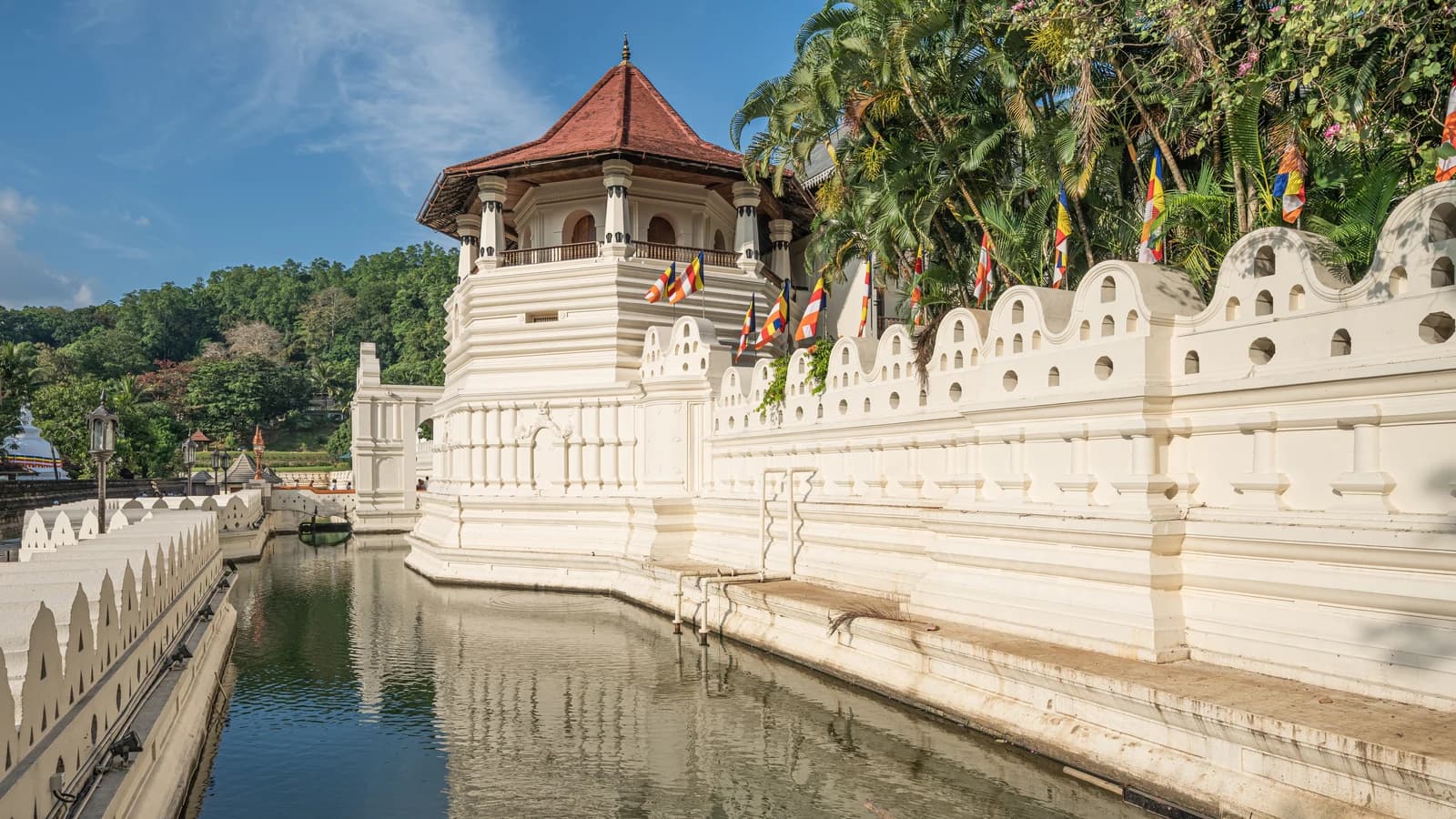
Sri Dalada Maligawa (the Temple of the Tooth Relic) sits on the north bank of Kandy Lake in the exact centre of the city. It's been here, in one form or another, since 1595. The relic it protects is a single tooth, said to belong to the Buddha, and it's considered so sacred that for over 2,000 years the ruler who held it held the right to govern Sri Lanka.
That tooth has never left the temple. The current king of Kandy hasn't existed since 1815. The drums still play three times a day.
Here's what to expect when you visit.
What the Temple Actually Is (And Why the Relic Matters So Much)
Most visitors know the broad outline. Fewer know the specifics, and the specifics are what make this place extraordinary.
The tooth arrived in Sri Lanka in 313 AD, smuggled out of the Kalinga Kingdom in India inside the hair of Princess Hemamali. The original was reputedly brought from Kushinagar, the city where the Buddha died and was cremated. Sri Lankan chronicles describe the tooth as roughly the size of a jasmine bud.
The temple complex built around it is called a Maligawa (a palace or royal residence), because the relic was historically considered a living king's most important possession. Control of the tooth meant legitimacy. When the Portuguese captured Galle and Colombo in the 1500s, their inability to seize the tooth was seen as proof of their incomplete conquest.
Today the relic is kept inside a gold casket, which sits inside five progressively larger caskets, in a room called the Vadahitina Maligawa on the upper floor. You won't see the tooth itself: the innermost casket is only opened during the Esala Perahera festival in July and August. What you will see is the outermost gold casket through a doorway, surrounded by offerings of flowers and oil lamps.
That's still enough to make the hair on your arms stand up.
The Layout: What You're Walking Into
The complex is bigger than it looks from the street. Budget at least 90 minutes to see it properly.
Walking through the main entrance from D.S. Senanayake Veediya, you cross a moat (actually part of the original 17th-century defensive design) and pass through the Mahawahalkada, the main gate tower. Look up at the octagonal Paththirippuwa tower to your right. It was originally used by kings to address their subjects. It now holds a library of ola leaf manuscripts.
The puja hall where the casket is displayed is on the upper floor of the main building. The line moves slowly during puja times (6 AM, 9:30 AM, and 6:30 PM), so expect 20 to 40 minutes of queuing. Outside puja hours, you can walk through in under 10 minutes.
Around the main shrine:
- Rajamala Vihara: a painting hall with detailed murals showing the relic's journey from India to Sri Lanka
- The Museum of the Temple: holds gifts sent to the temple by foreign heads of state, historic palanquins, and a life-size elephant tusk from Maligawa Raja, the temple's most famous elephant
- Aluth Maligawa: a newer shrine hall built in 1952, used for ceremonial purposes
The whole complex faces east toward the sunrise, which is standard for Buddhist shrines.
Visiting During Puja: What Actually Happens
Three times a day, at 6 AM, 9:30 AM, and 6:30 PM, the temple holds a puja ceremony, an offering ritual for the relic.
This is when the drums start.
A group of traditional musicians called the hewisi plays in the courtyard below the relic chamber. They use davul drums, thammatam kettle drums, and a long straight horn called a hakgediya made from a conch shell. It's loud in a way that feels intentional: the kind of sound that's designed to be felt rather than just heard.
The doors to the relic chamber open and devotees press forward, arms full of cut flowers (temple lotus, white araliya, jasmine) to lay at the threshold of the inner shrine. Monks in saffron robes move through the crowd performing blessing rituals.
If you can only visit once, go at 6:30 PM. The golden lamplight in the shrine hall, the flower offerings piled high, and the drum sound carrying across the lake make it one of the most atmospheric hours anywhere in Sri Lanka.
Get there 20 minutes early. The queue on the left side of the entrance courtyard moves faster.
What Is the Temple of the Tooth Relic Like to Visit? Common Questions Answered
Do you have to be Buddhist to enter? No. The temple is open to all faiths. Respectful visitors of any background are welcome.
What should you wear? Shoulders and knees must be covered. You must remove shoes before entering the inner shrine area. Sarongs are available to borrow free at the entrance if you arrive in shorts.
How much does it cost? The entrance fee for foreign visitors is LKR 1,500 (approximately USD 5 as of 2025). Sri Lankan nationals enter free. Photography inside the relic chamber is not permitted.
Can you take photos? Yes, throughout most of the complex. The restriction applies only to the inner shrine room where the casket is displayed. The courtyard, moat, and painting halls are all fair game.
How long does a visit take? 60 to 90 minutes covers everything comfortably. Add 30 minutes if you visit during puja and queue for the relic chamber.
Is it crowded? Yes, especially on Poya (full moon) days, which are national Buddhist holidays in Sri Lanka. If you're visiting mid-week and avoiding Poya, it's manageable. Weekends in July and August during Esala Perahera season are extremely busy.
Getting There and When to Go
The temple is a 5-minute walk from Kandy's main bus terminal and a 10-minute walk from the train station. Tuk-tuks from anywhere in the city centre cost around LKR 150 to 250, genuinely not worth it given the distance, but useful in rain.
The best time to visit Kandy for the temple specifically:
- Any Poya day: the full moon falls on a different date each month. Poya days see large numbers of white-clad devotees, masses of flowers, and the most active atmosphere of any regular day.
- Esala Perahera (July/August): the 10-day festival centred on the tooth sees the relic casket paraded through the city on an elephant's back. It's the biggest cultural event in Sri Lanka and the temple is at the centre of it.
- Early morning on a weekday: the 6 AM puja is the quietest. The crowd is almost entirely local, the air is cool, and the light inside the shrine hall is softer.
Avoid Sunday afternoons and public holidays unless you specifically want to see the temple at its most crowded, which can actually be its own kind of remarkable.
What to Do After You Visit
The temple sits on a square that connects directly to the rest of central Kandy. You're 8 minutes on foot from the Kandy Market, 10 minutes from the Udawattakele Sanctuary trailhead, and 15 minutes from Bahiravokanda, the giant white Buddha statue on the hilltop above the city.
Kandy Lake itself is worth 30 minutes of your time. The path around it is just under 4 kilometres and gives you constant views back to the golden roof of the temple from the opposite bank.
If the 6:30 PM puja lines up with your evening, finish with dinner along Dalada Veediya, the strip of restaurants that runs east from the temple complex. The lake lights up at night and the whole area slows to a pace that feels very different from the daytime traffic.
The temple won't be the most spectacular building you've ever walked into. But it's probably the most quietly powerful. There's something in the weight of what people believe is kept here that changes how the room feels.
Go once. Give it more than 20 minutes.
Want to explore more?
Download our comprehensive E-Travel Guidebook for this destination.