Peradeniya Royal Botanical Gardens: A Green Escape from Kandy
By Stay Lanka Travels
The Royal Botanical Gardens at Peradeniya are six kilometres from central Kandy and worth half a day of anyone's trip. This guide covers what's inside, the best areas to explore, and exactly how to plan the visit.
The avenue hits you before you're ready for it.
You walk through the entrance gate expecting a park and instead you're standing at the base of a double row of royal palms that stretches a quarter of a kilometre ahead, each trunk dead straight, each crown so high up it feels detached from the tree below it. The scale is simply wrong, in the best way possible.
That's the moment most people decide to stay longer than they planned.
The Royal Botanical Gardens at Peradeniya are six kilometres west of Kandy along the Colombo road. They cover 147 acres on a bend of the Mahaweli River, the largest river in Sri Lanka. The gardens were established formally in 1821 under British colonial administration, though the land had been maintained as a royal pleasure garden by Kandyan kings long before that. What's here now is the result of 200 years of planting, collecting, labelling, and tending by botanists who knew what they were building.
It shows.
What's Inside: The Layout in Plain Terms
The gardens are large enough that you need a loose plan, otherwise you'll spend your whole visit in one corner and miss the best parts.
The main entrance on the A1 road drops you at the south end. From there, the palm avenue runs north through the central spine of the grounds, with the Mahaweli River curving around the eastern boundary. Several distinct garden areas branch off the main path, each with a different character and a different purpose.
The easiest way to navigate is to follow the central avenue north and let the side paths pull you off it when something catches your eye. Most people take one or two complete loops covering the highlights in three to four hours.
Tuk-tuks and bicycles can be rented inside the grounds, which sounds convenient but mostly isn't — the gardens are the kind of place that rewards walking slowly and stopping often. A tuk-tuk gets you past everything faster than you can see it.
The Areas Worth Your Time
The Great Circle at the heart of the grounds is where the lawns open up into wide, manicured fields. School groups picnic here. Couples walk in circles. The grass is cut short and the view across the lawns toward the river is exactly what you imagine when someone says "botanical garden."
The Orchid House is a greenhouse tucked toward the western side, holding an extensive collection of tropical orchids. The humidity inside is immediate and total. Varieties are labelled, which is useful if you're interested in names; the colours make it worthwhile even if you're not.
The Avenue of Cinnamon runs parallel to the main palm avenue. The trees are the source of Sri Lanka's signature spice, Cinnamomum verum, and up close they look completely ordinary — smooth grey-barked trees that give no indication of what's underneath the surface bark. Crush a leaf between your fingers and that changes immediately.
The Giant Bamboo section near the northern boundary contains Dendrocalamus giganteus, a Burmese bamboo species that grows to extraordinary sizes. These are not the decorative bamboo you might have seen in a garden centre. Some culms are a foot in diameter and the sound they make in a breeze, a low, structural creak, is genuinely strange.
And then there are the trees. Enormous, labelled specimen trees scattered throughout the grounds: cannonball trees (Couroupita guianensis) with their strange clustered flowers growing directly from the trunk, a 150-year-old Ficus benjamina that has spread its aerial roots into a small forest of its own, the sprawling double coconut palms from the Seychelles that produce the world's largest seeds.
The Java Fig: One Tree That Deserves Its Own Paragraph
Near the river on the eastern side of the gardens stands a Ficus benghalensis, an Indian banyan, that has been growing here since 1875. It covers roughly a quarter of an acre. The aerial roots it has dropped over 150 years have become secondary trunks, which have dropped more roots, which have become more trunks.
You walk into it the same way you walk into a room.
From the outside it looks like a thicket. From the inside, there's actual space, a canopy, a cool that's distinct from the surrounding air, and the sense of being inside something that is continuously building itself. It's one of the more quietly remarkable things in the hill country.
Practical Details That Actually Matter
Getting there: A tuk-tuk from central Kandy to the gardens takes 15 to 20 minutes depending on traffic and costs around LKR 300 to 500 one way. The A1 Colombo road can get congested on weekday mornings. Alternatively, any Colombo-bound bus from the Kandy main bus stand passes through Peradeniya — ask the conductor and get off at the gardens junction.
Entrance fees: There's a fee for foreign visitors (check current rates with your accommodation before visiting, as they're revised periodically). Sri Lankan nationals pay a lower rate. The ticket includes access to the whole garden. The Orchid House may have a separate entry charge at certain times.
When to go: Early morning is genuinely different from midday. The gardens open at 7:30 AM and the first two hours are quiet, the light is right for photographs, and the temperature under the big trees is cool enough to be comfortable. By 11 AM the tour groups are arriving in number and the open lawns heat up fast.
How long to allow: Three hours is the minimum to see the main areas without rushing. Four hours is more comfortable. The gardens are large enough that you won't cover everything in a single visit, and they're not the sort of place that rewards rushing.
Peradeniya as a Half-Day from Kandy
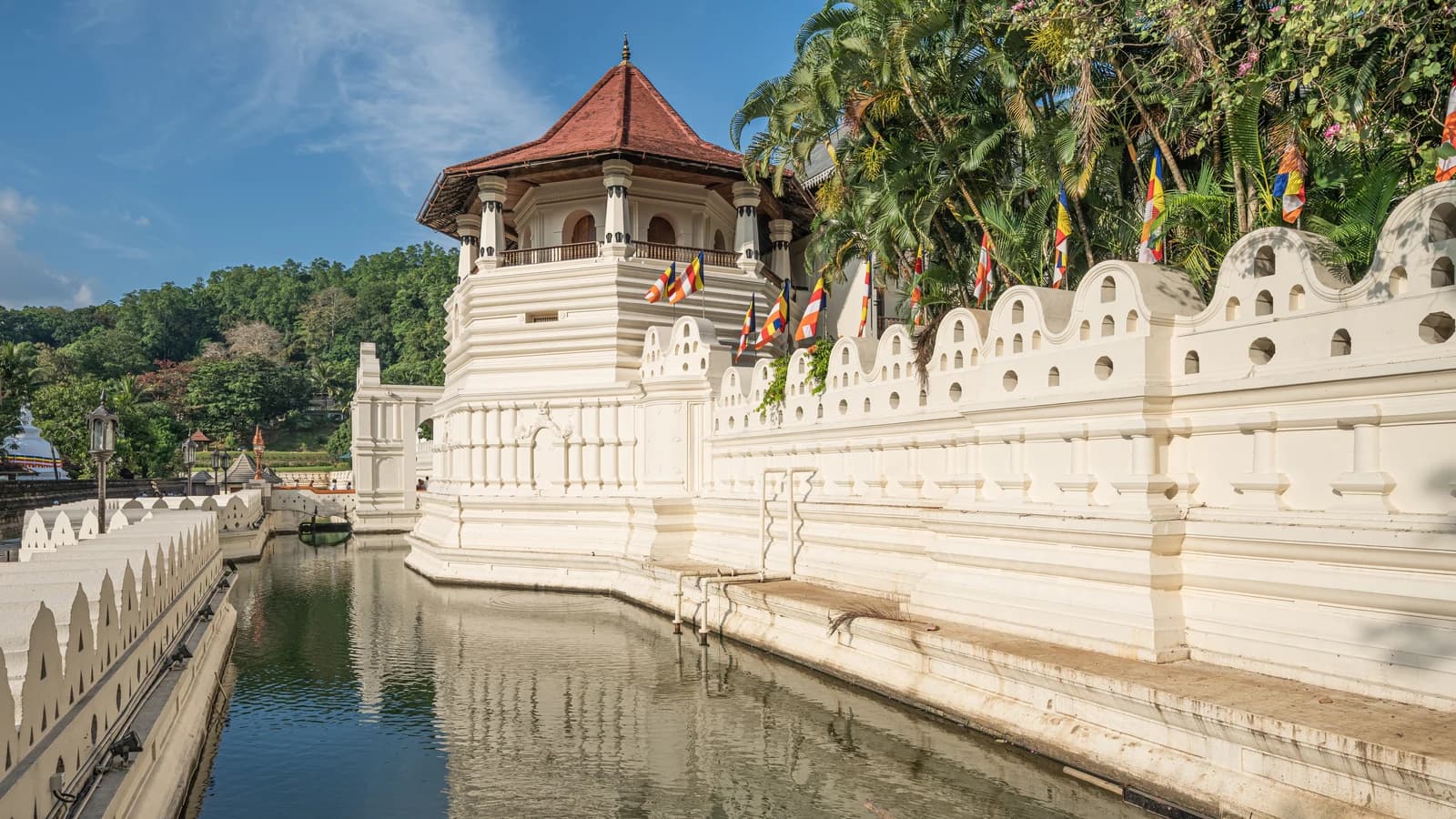
The gardens work well as a morning excursion from a Kandy base. Leave by 8 AM, spend the morning inside, and you're back in the city by early afternoon with enough time for the Temple of the Tooth's 6:30 PM puja and dinner around Kandy Lake.
The surrounding area is also worth knowing. The University of Peradeniya campus is immediately adjacent to the botanical gardens, one of the most beautiful university campuses in South Asia, with colonial-era buildings set into the same river bend landscape. The campus is semi-open; it's worth a look if you have extra time.
Peradeniya train station is about a kilometre from the gardens and sits on the Kandy-Colombo line. If you're arriving or departing from Colombo, it's theoretically possible to stop at Peradeniya station before reaching Kandy. In practice this only makes sense if you're carrying minimal luggage and have the logistics clearly worked out.
Questions Travellers Ask About Peradeniya Botanical Gardens
How far is Peradeniya from Kandy? Six kilometres west of central Kandy on the A1 Colombo road. A tuk-tuk takes 15 to 20 minutes depending on traffic and costs around LKR 300 to 500 each way. Public buses on the Kandy–Colombo route also stop at the gardens junction.
How long does a visit to Peradeniya take? Three to four hours covers the main areas comfortably. The grounds are 147 acres, so you won't see every section in a single visit. Going early means you avoid the tour group rush that starts around 10:30 AM.
Is Peradeniya worth visiting if you've already seen botanical gardens elsewhere? Yes. The scale, the age of the specimen trees, and the river setting make Peradeniya genuinely different from most botanical gardens. The 150-year-old banyan alone is worth the visit. What's here is the result of two centuries of serious botanical collection, not a decorative park.
What's the best time of day to visit Peradeniya Botanical Gardens? Early morning, between 7:30 AM and 10:00 AM. The grounds are cooler, much quieter, and the low light is far better for photographs in the palm avenue and under the large tree canopy. Midday on the open lawns is uncomfortably hot.
Can you eat inside Peradeniya Botanical Gardens? There's a cafeteria inside the grounds near the main entrance area. It's basic — short eats, rice and curry, bottled drinks — but functional if you need something mid-visit. Bring water regardless, especially if you're visiting between April and September.
The Gardens Don't Ask Anything of You
That's what makes them a good half-day in a city that tends to ask a lot.
Kandy is a place of significance — religious, historical, cultural — and most of its major sites require a certain posture. You remove your shoes, you lower your voice, you follow the rules. All of that is worth it. But there's also something to be said for a place where you can just walk under a 150-year-old tree, sit on the grass by the river, and let the afternoon settle.
The banyan will still be growing. The palms will still be absurdly tall. The cinnamon will smell like cinnamon when you crush a leaf, the same way it did for the botanists who planted it two centuries ago.
That kind of continuity is its own kind of remarkable.
Browse our Kandy destination guide for where to stay, what else to visit, and how to plan your time in the hill capital.
Want to explore more?
Download our comprehensive E-Travel Guidebook for Ella.