Minneriya National Park: Elephants, Jeep Safaris and What to Expect
By Stay Lanka Travels
Your complete guide to visiting Minneriya National Park, the best place in Sri Lanka to see wild elephants in large numbers, with safari tips, timing, and what actually happens on a jeep tour.
The driver cuts the engine and you coast to a stop on the dry grass.
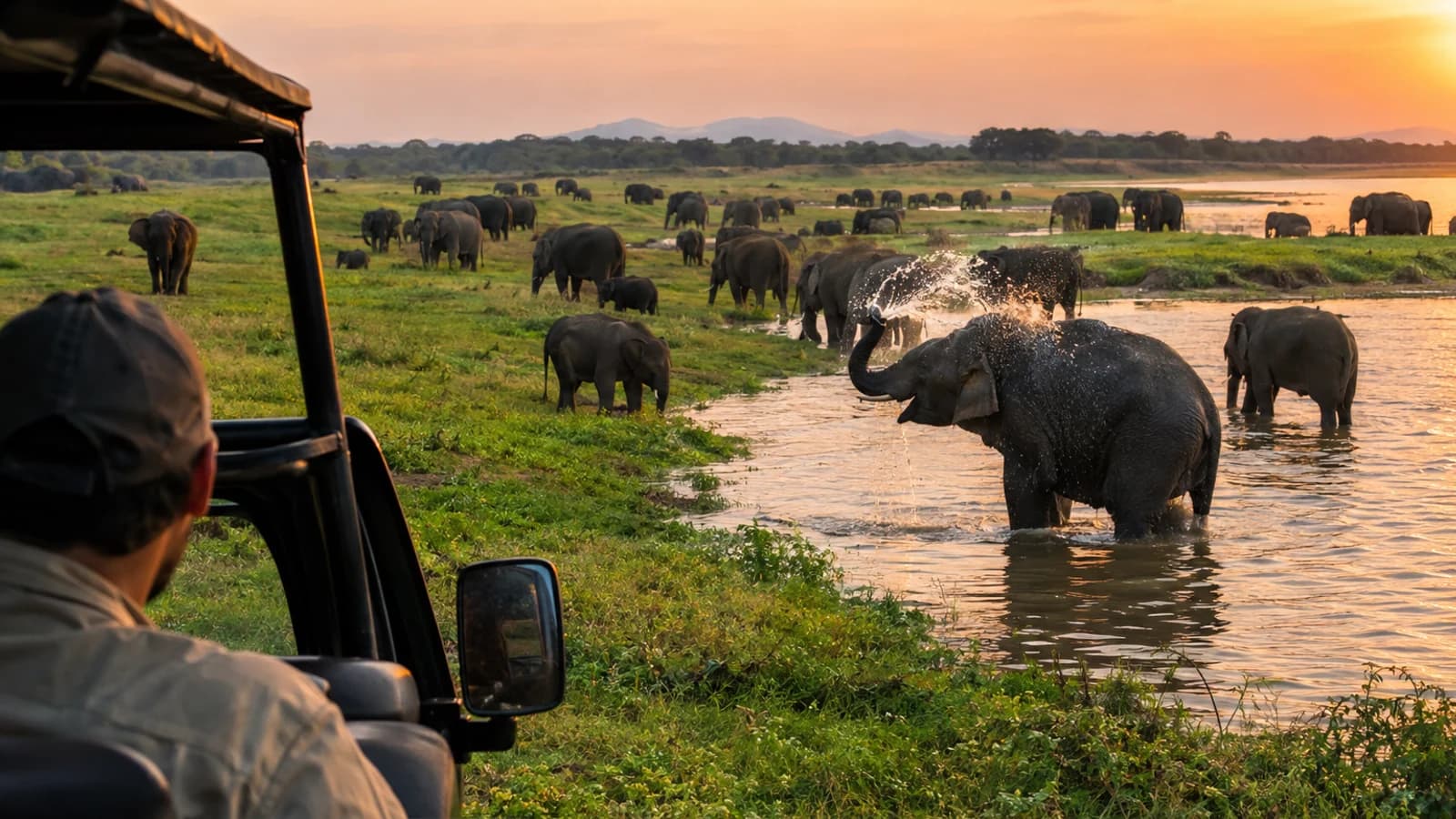
Forty metres ahead, a bull elephant is standing in the shallows of the tank, pulling water up his trunk and spraying it across his back. Behind him, maybe 80 more elephants are spread across the plain: mothers, calves, young bulls, all moving slowly toward the water as the afternoon light turns orange.
Nobody says anything. The jeep is silent.
This is Minneriya in August, and what you're watching is called The Gathering, the largest concentration of wild Asian elephants on the planet. Up to 300 elephants come together here between July and October when the ancient reservoir drops and exposes a kilometre of rich green grass along its banks.
Nothing else in Sri Lanka is quite like it.
Why Minneriya Exists Where It Does
The park wasn't created for elephants. It was created around water.
King Mahasena built the Minneriya Tank in the 3rd century AD as part of an irrigation network that fed the ancient cities of Anuradhapura and Polonnaruwa. The reservoir is massive (4,670 acres at full capacity) and it still irrigates farmland for thousands of families today.
When the dry season hits between July and October, the tank level drops. The receding waterline exposes a belt of fresh grass around the perimeter, grass that grows faster than the elephants can eat it. Word gets around, as it apparently does among elephants. They come from across a 200-kilometre range that spans Minneriya, Kaudulla, and Wasgamuwa national parks. The route they use is called the Elephant Corridor, and it has existed for longer than any road in Sri Lanka.
Minneriya National Park itself covers 8,890 hectares of dry zone forest, wetland, and open grassland around the tank. It was declared a national park in 1997, partly to protect the corridor and partly because by then it was obvious something extraordinary happened here every year.
The tank is the reason. The elephants follow the water.
The Gathering: What It Is and When to Go
The Gathering is not guaranteed. It's a natural event tied to rainfall, tank water levels, and elephant movement patterns. But it is predictable enough that you can plan around it.
The best months are July, August, and September. August is peak: the tank is at its lowest, the grass on the exposed banks is at its most abundant, and elephant numbers are at their highest. On a good August afternoon, guides report counts of 150 to 300 elephants visible simultaneously from a single vantage point.
Outside these months, Minneriya still has elephants. The park supports a resident population of around 200 throughout the year. But the Gathering (the massed convergence at the tank) only happens in the dry season.
If you're visiting between November and May, consider Kaudulla National Park instead, which is 22 kilometres northeast of Minneriya. Kaudulla operates its own tank with a similar grassland margin and typically has better elephant density during the wet season when Minneriya quietens down. Many safari operators run combined Minneriya-Kaudulla itineraries that switch between the two parks depending on the week's conditions. Ask specifically which park the jeep is going to before you book.
The short answer: go between July and October, go in the afternoon, and don't plan it for December.
What Happens on the Jeep Safari
The standard safari runs 3 to 4 hours. Most depart in the afternoon (usually 2:00 PM or 3:00 PM) and return around 6:00 PM or 6:30 PM. The afternoon timing is deliberate. Elephants move toward the tank as the day cools and the heat of the afternoon lifts.
Morning safaris exist but are less reliable for The Gathering. They're better for birdwatching: Minneriya has over 160 recorded bird species including painted storks, grey pelicans, and purple-faced langurs that are strictly speaking monkeys but tend to appear in the same conversations.
The route through the park changes daily depending on where the elephants are. Your driver and tracker will communicate by radio with other jeep crews throughout the afternoon. This is standard; don't read anything into it. They're sharing sightings.
What you'll typically see during a full afternoon safari:
- Tank-side grassland: This is where The Gathering happens. Jeeps park along the bank and cut engines.
- Forest interior: On the way in and out, you pass through dry zone scrub forest. This is where you're most likely to see spotted deer, sambar, and occasionally leopard tracks, though leopard sightings are rare and not something to count on.
- Wetland margins: Look for painted storks nesting in the tall trees above the water's edge. In August, the nesting colonies are large enough to be heard before they're seen.
You will not be alone on the safari. On peak-season weekends, there can be 20 or more jeeps parked near the elephants at the same time. It's not wilderness in the classic sense; it's more like a very large, very wild outdoor event. The elephants are entirely indifferent to the jeeps. That's actually reassuring.
What Is Minneriya National Park Like? Common Questions Answered
How close do you get to the elephants? Very close. Jeeps routinely stop 10 to 30 metres from elephants at the tank. Elephants occasionally walk within a few metres of vehicles. Your driver will move if an elephant signals discomfort (ears spread, head raised, short charge). Trust the driver's judgment on this.
Is it safe? Yes, with caveats. You stay in the jeep. You don't stand up or extend limbs outside the vehicle near elephants. Bull elephants in musth (a hormonal condition that makes them unpredictable) are given a wide berth by experienced drivers.
How much does it cost? Entrance fees for foreign visitors are approximately USD 25 per person (2025 rates), payable at the park gate. Jeep hire costs LKR 7,000 to 12,000 for a full vehicle depending on the operator (split between 4 to 6 passengers, it's very reasonable). Book through your guesthouse in Sigiriya or Habarana, not through intermediaries in Colombo.
Do you need to book in advance? In July and August, yes. Peak season fills up quickly and good jeeps with experienced drivers go first. Book 2 to 3 days ahead minimum.
How long is the drive from Sigiriya? Minneriya is 25 kilometres from Sigiriya, about 35 minutes by road. From Dambulla, it's 30 kilometres, roughly 45 minutes.
What should you wear? Neutral colours: khaki, beige, olive. Not white (reflects glare that can startle animals) and not bright colours. Bring a light layer for the return journey; it gets cool quickly after sunset.
Practical Things to Sort Before You Go
Most visitors to Minneriya are based in either Sigiriya or Habarana, both of which are well-positioned for early departures and have a good range of safari operators.
Habarana is marginally closer to the park entrance and has more budget accommodation options. Sigiriya has better restaurants and the obvious advantage of being next to Sigiriya Rock, so most itineraries that include both Sigiriya and Minneriya use it as a base.
A few things to confirm when booking your jeep:
- Which park? Confirm whether the driver is going to Minneriya or Kaudulla. They're different parks with different gate fees and different conditions depending on the month.
- Is the driver a licensed tracker? The Department of Wildlife Conservation requires licensed naturalist guides for jeeps. Ask your guesthouse to confirm this before booking.
- What's included in the price? Gate fees are typically separate from jeep hire. Get clarity on this before you hand over money.
Bring a camera with a zoom lens if you have one: phone cameras work at close range, but the tank-side scenes where elephants are spread across a wide plain need optical zoom to capture properly. A pair of binoculars for birdwatching is worth the bag space.
The Elephant Corridor and Why It Matters Beyond the Safari
What happens in Minneriya is ecologically unusual. Three hundred elephants gathering in one place is a spectacle, but it's also a sign of something harder to protect: the land between the parks.
The Elephant Corridor that links Minneriya, Kaudulla, and Wasgamuwa runs through private farmland, village boundaries, and increasingly, new roads. Elephants use it year-round to move between water sources. When the corridor gets blocked (by fencing, by development, by new settlements) elephants are pushed into human areas. Crop raiding and human-elephant conflict follow quickly.
Several conservation organisations work specifically on corridor protection in this region. The Minneriya safari you take contributes park revenue that funds rangers, anti-poaching patrols, and habitat monitoring. It's not wildlife tourism as an afterthought: it's the primary funding mechanism for keeping the corridor open.
Go for the elephants. Stay for the understanding of what it takes to keep them here.
Then go see Sigiriya the next morning. You're 25 kilometres away and you've already made the drive worth it.
Want to explore more?
Download our comprehensive E-Travel Guidebook for this destination.