Dambulla Cave Temple: History, Caves and the Story Behind Sri Lanka's Golden Temple
By Stay Lanka Travels
Explore the history, significance, and the five incredible caves of the Dambulla Cave Temple, a living religious site and a must-visit in Sri Lanka.
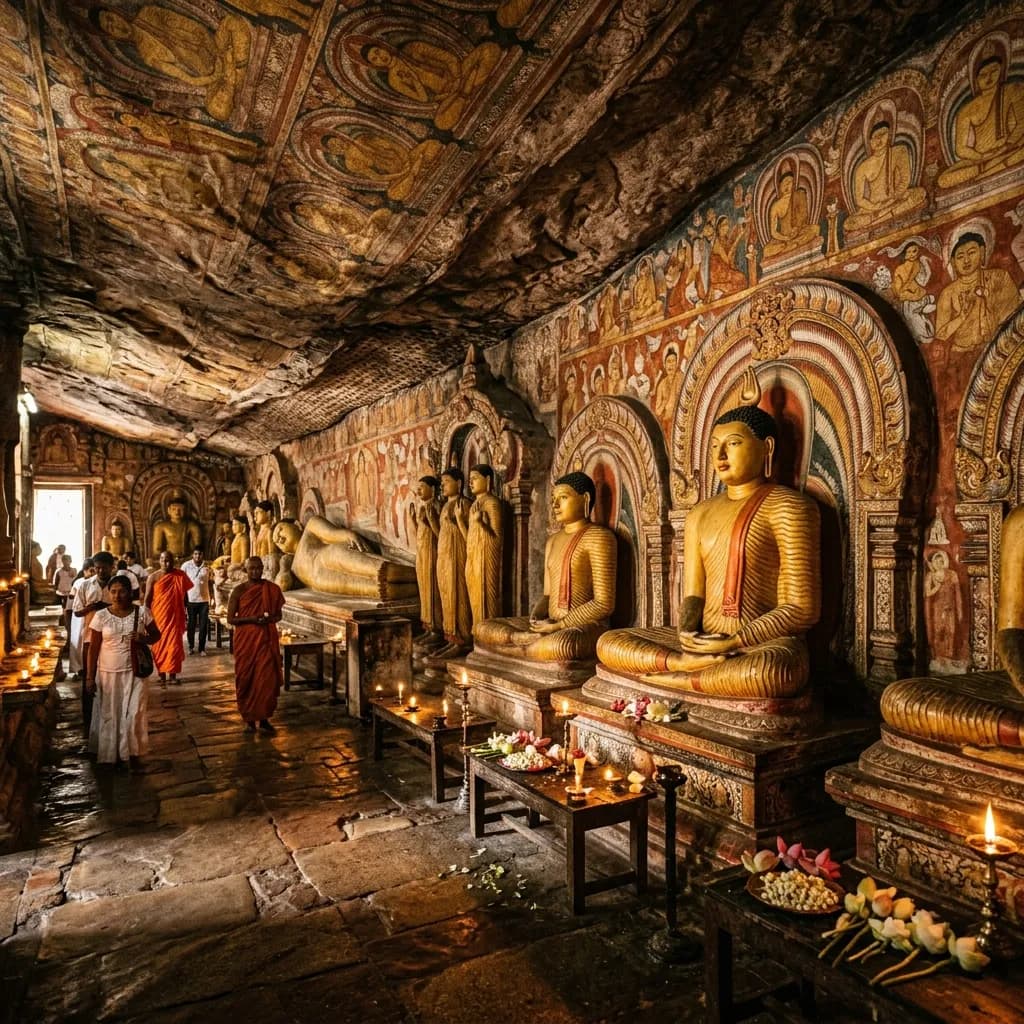
Rising 160 metres above the central plains, Dambulla's dark granite monolith looks impenetrable from a distance. Yet tucked beneath its massive overhanging brow, sheltered behind a whitewashed colonnade, rests the largest and best-preserved cave temple complex in South Asia. Step through the doorways from the sun-drenched courtyard, and the tropical heat vanishes instantly, replaced by cool shadows, the faint scent of incense, and the silent gaze of more than 150 Buddha statues.
Unlike the ruins of Sigiriya or Anuradhapura, Dambulla has never fallen silent. For over twenty-two centuries, monks, kings, and pilgrims have walked these same flagstones and replenished the oil lamps. What began in the 3rd century BCE as a forest hermitage evolved into an extraordinary sanctuary housing 153 Buddha statues, royal figures, and over 2,100 square metres of painted ceiling murals. Here is the story behind the Golden Temple of Dambulla, what waits inside its five sacred caverns, and how to plan your visit.
A 2,200-Year Sanctuary: From Exile to Royal Shrines
Dambulla's emergence as a royal sanctuary began during a national crisis. In 103 BCE, King Valagamba took the throne at Anuradhapura, only to be driven into exile months later by South Indian invaders. Fleeing into the central wilderness, the king found refuge in Dambulla's natural caves, where hermit monks concealed and protected him for fourteen years.
When Valagamba rallied his forces and regained his crown in 89 BCE, he transformed these rock shelters into monumental shrines (viharas) in gratitude. Stone masons cut drip-ledges (katarama) along the high cliff brow to divert monsoon rains and engraved Brahmi dedications to the Sangha.
Later monarchs expanded the complex across the centuries:
- King Nissankamalla (1187-1196 CE): Gilded seventy-three statues in gold leaf and commemorated his work in a rock inscription near Cave II, giving the site its enduring name, Rangiri Dambulla (Golden Rock of Dambulla).
- The Kandyan Kings (17th-18th Centuries): Under King Kirti Sri Rajasinha, master painters created the sweeping tempera ceiling murals that define the caves' visual aesthetic today.
- Early 20th Century: Monks converted an old storehouse into Cave V, proving Dambulla remains an evolving house of worship rather than a static relic.
Ascending the Rock: The Approach and Courtyard
Reaching the caves involves ascending roughly 360 shallow granite steps up the sloping rock ridge. While far gentler than Sigiriya's steep ladders, the 15-minute climb can be warm work under the morning sun.
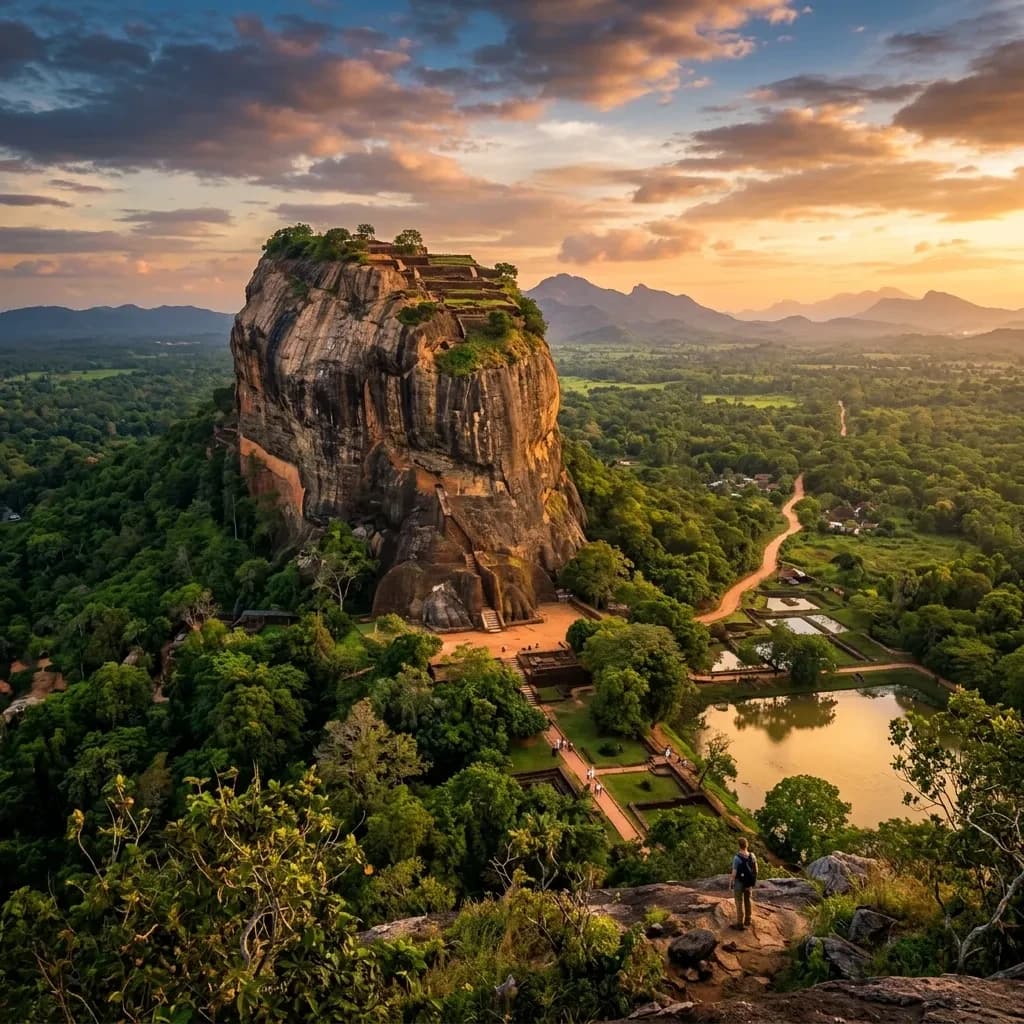
As you climb, the dry-zone forest unfurls below, with Sigiriya visible on clear mornings as a sharp silhouette to the north. Fragrant frangipani blossoms scatter across the stone stairs, while troops of toque macaque monkeys watch from shaded ledges. Keep food, plastic bottles, and flower offerings secured in your daypack, as these primates are bold foragers.
At the top, the path opens onto a granite terrace bordered by a lily pond, a bodhi tree, and the iconic white portico built against the cliff. Visitors remove their footwear at the storage counter before stepping barefoot onto the sacred flagstones.
Inside the Five Sacred Caverns
Each cavern reflects a distinct era of Sri Lankan art and architecture, arranged chronologically from west to east.
Cave I: Devaraja Lena (Cave of the Divine King)
Entering Cave I brings an immediate sense of intimacy. The narrow chamber is dominated by a monumental 14-metre (46-foot) reclining Buddha carved directly from the living granite bedrock, capturing the Buddha entering Parinirvana at the moment of death. Traces of ancient red and gold pigment still cling to the carved robe, while lotus wheels adorn the soles of his feet. At his head sits a small shrine dedicated to the god Vishnu, who according to legend aided the stone masons, while his disciple Ananda stands weeping at his feet.
Cave II: Maharaja Lena (Cave of the Great Kings)
Maharaja Lena is Dambulla's grandest sanctuary. Spanning roughly 52 metres wide and 7 metres tall, it houses fifty-six statues, including standing, seated, and meditating Buddhas, alongside painted life-sized sculptures of King Valagamba and King Nissankamalla.
Near the center, an iron-caged bronze vessel catches a perpetual trickle of water dripping from an internal ceiling fissure. The water flows along the rock contours before falling drop by drop into the urn, never stopping even in droughts, and is reserved exclusively for temple rituals. Overhead, the undulating rock ceiling is blanketed in tempera murals depicting the Buddha's life, Prince Vijaya's arrival, and King Dutugemunu's historic battles.
Cave III: Maha Alut Vihara (The Great New Temple)
Commissioned in the late 18th century by King Kirti Sri Rajasinha during the Kandyan revival, this cavern is spacious and harmonious. It features fifty statues, highlighted by a 9-metre reclining Buddha along the back wall and a statue of the king in ceremonial court regalia near the entrance. The ceiling displays classic Kandyan folk art, with hundreds of meditating Buddhas arranged in neat horizontal bands across deep ochre backgrounds.
Cave IV: Pashchima Vihara (The Western Temple)
This compact chamber features a serene seated Buddha in meditation posture (dhyana mudra), framed by an ornate Makara Torana (mythological dragon archway). In the center stands the Soma Chetiya, a small stupa believed to have once held the jewelry of King Valagamba's queen, Somawathi. A patched scar on the masonry marks where 19th-century treasure seekers broke in looking for jewels.
Cave V: Devana Alut Vihara (The Second New Temple)
The newest cave was converted from a storehouse into a shrine in 1915. Its eleven statues are sculpted from brick and plaster rather than granite bedrock. Alongside a reclining Buddha, the cave includes statues of Hindu deities like Kataragama (Murugan) and Vishnu, illustrating centuries of peaceful religious syncretism in Sri Lanka.
The Art of the Cave Ceiling Murals
Covering 2,100 square metres, Dambulla's painted ceilings form one of the world's most extensive collections of religious rock art. Instead of painting onto wet plaster, artisans applied natural tempera pigments over a prepared dry ground of clay, sand, straw, and burnt lime.
The paints were derived entirely from local materials:
- Reds and ochres: Ground from iron-rich clays.
- Blacks: Produced from charred coconut shells and soot.
- Whites: Made from kaolin clay and crushed seashells.
- Yellows: Extracted from forest tree resins.
Rendered in the distinctive Kandyan style with stylized figures, rhythmic narrative panels, and repeating lotus motifs, these murals have retained their luminosity across centuries, shielded from rain, wind, and direct sunlight.
Practical Logistics and Temple Etiquette
As an active Buddhist sanctuary, strict visitor protocols apply:
- Buy Tickets at the Base: The ticket office is located at the bottom near the museum and parking area. There is no ticket counter at the summit; visitors who climb up without tickets must walk back down.
- Dress Respectfully: Shoulders and knees must be fully covered. Hats, caps, and sunglasses must be removed before entering the courtyard.
- Bring Thick Socks: Shoes must be checked at the entrance. By mid-morning, the black granite courtyard absorbs intense heat; a pair of thick socks protects your soles while complying with temple rules.
- Photography Rules: Flash photography is strictly forbidden inside the caves to protect fragile pigments. Never pose with your back turned toward a Buddha statue.
- Best Visiting Hours: Arrive between 7:30 AM and 9:00 AM to explore before tour groups arrive, or around 4:00 PM for softer light and cooler breezes.
Exploring Beyond Dambulla: The Sigiriya Connection
Located just 20 kilometres south of Sigiriya, Dambulla pairs naturally with the ancient fortress. Where Sigiriya represents secular royal power and daring engineering, Dambulla offers a contemplative encounter with sacred art and enduring faith.
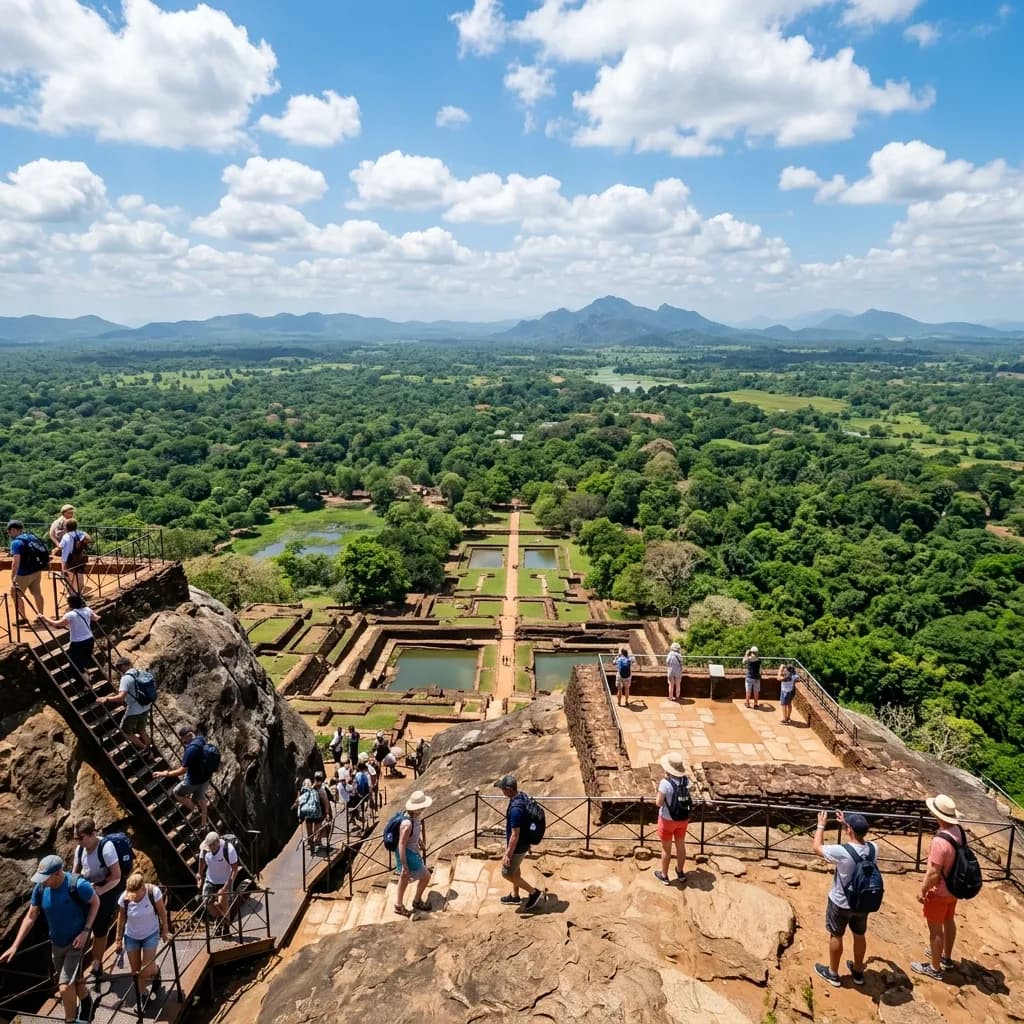
A popular itinerary begins with an early climb of Sigiriya Rock at 6:30 AM before the heat builds, followed by a midday rest and a late-afternoon visit to Dambulla. Visiting both gives you a complete perspective on how ancient builders shaped stone, nature, and spirituality in Sri Lanka's dry zone.
The Final Verdict
Stepping from the dim caves back into the daylight, the contrast is unforgettable. The plains stretch out below, dotted with ancient irrigation reservoirs (wewas) reflecting the tropical sky.
Dambulla is more than an ancient gallery; it is a living sanctuary of human resilience and devotion. From an exiled king hiding in the shadows to generations of monks and artisans painting raw stone by candlelight, the caves carry an unbroken spiritual lineage spanning twenty-two centuries. It remains one of Sri Lanka's most evocative cultural experiences, and an essential highlight of the Cultural Triangle.
Want to explore more?
Download our comprehensive E-Travel Guidebook for Ella.