Dambulla and Sigiriya: Two Ancient Wonders on Sri Lanka's Cultural Triangle
By Stay Lanka Travels
Dambulla and Sigiriya sit 17 kilometres apart in Sri Lanka's Cultural Triangle. This guide explains what each site offers, why they work better together than as separate stops, and how to plan a visit that does both justice.
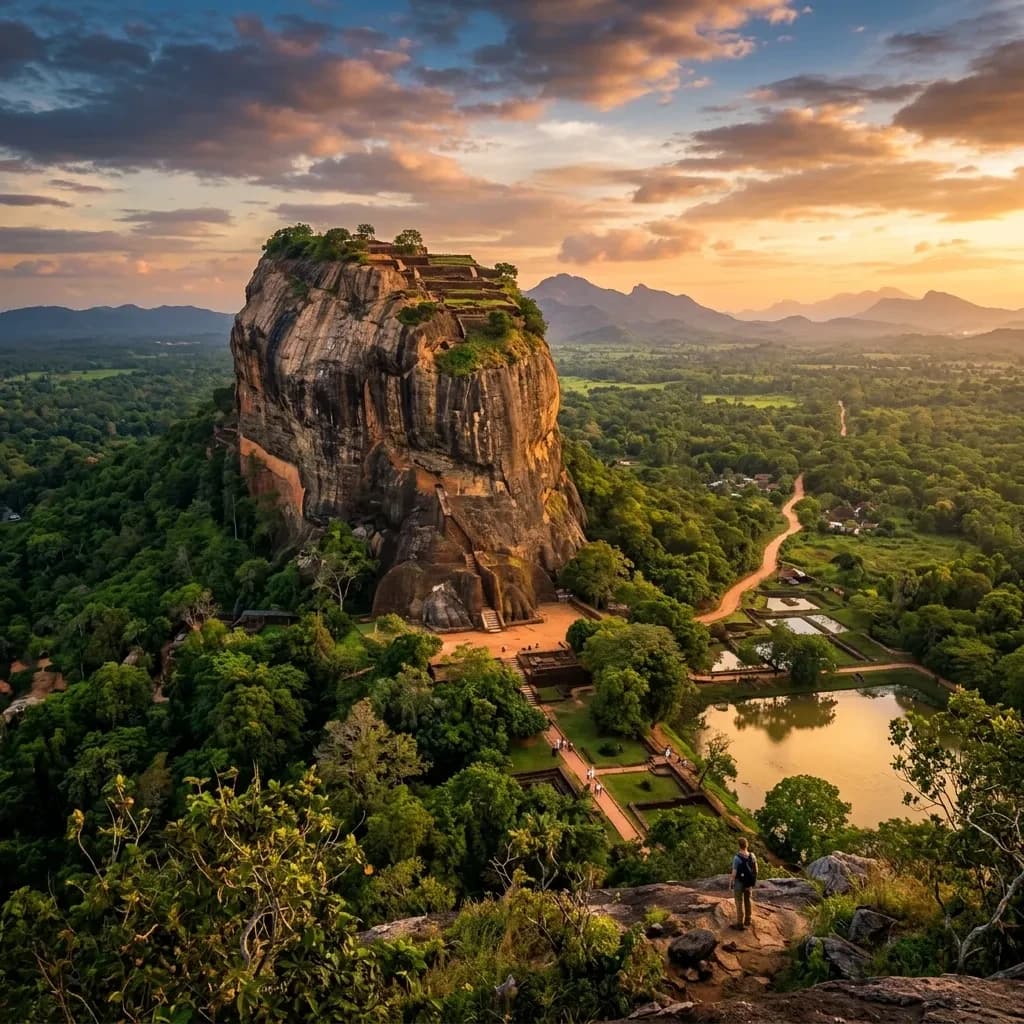
You spot Sigiriya Rock long before you reach it. From the highway north of Dambulla, the summit breaks out of flat dry-zone jungle , a 200-metre column of reddish granite with vertical walls on all sides. There's nothing around it that would explain it. No ridge, no hill range. It just appears, and keeps appearing every time a gap opens in the treeline.
Dambulla is different. You have to climb to find what it contains. The rock face from the road shows nothing except a long granite slope and a golden Buddha statue at its base. The five cave temples are cut into the overhang 160 metres above, invisible until you're standing in front of them.
Two ancient sites, 17 kilometres apart, completely different in what they ask of you. That's why most people visit both in the same trip. And why doing them separately, if you have the time, is almost always the better choice.
Dambulla: More Than a Stop on the Way to Sigiriya
Dambulla gets treated as a transit point , the place you sleep before the early-morning Sigiriya climb. That's a mistake. The Dambulla Cave Temple is one of the most significant Buddhist sites in Asia, and it takes real time to absorb properly.
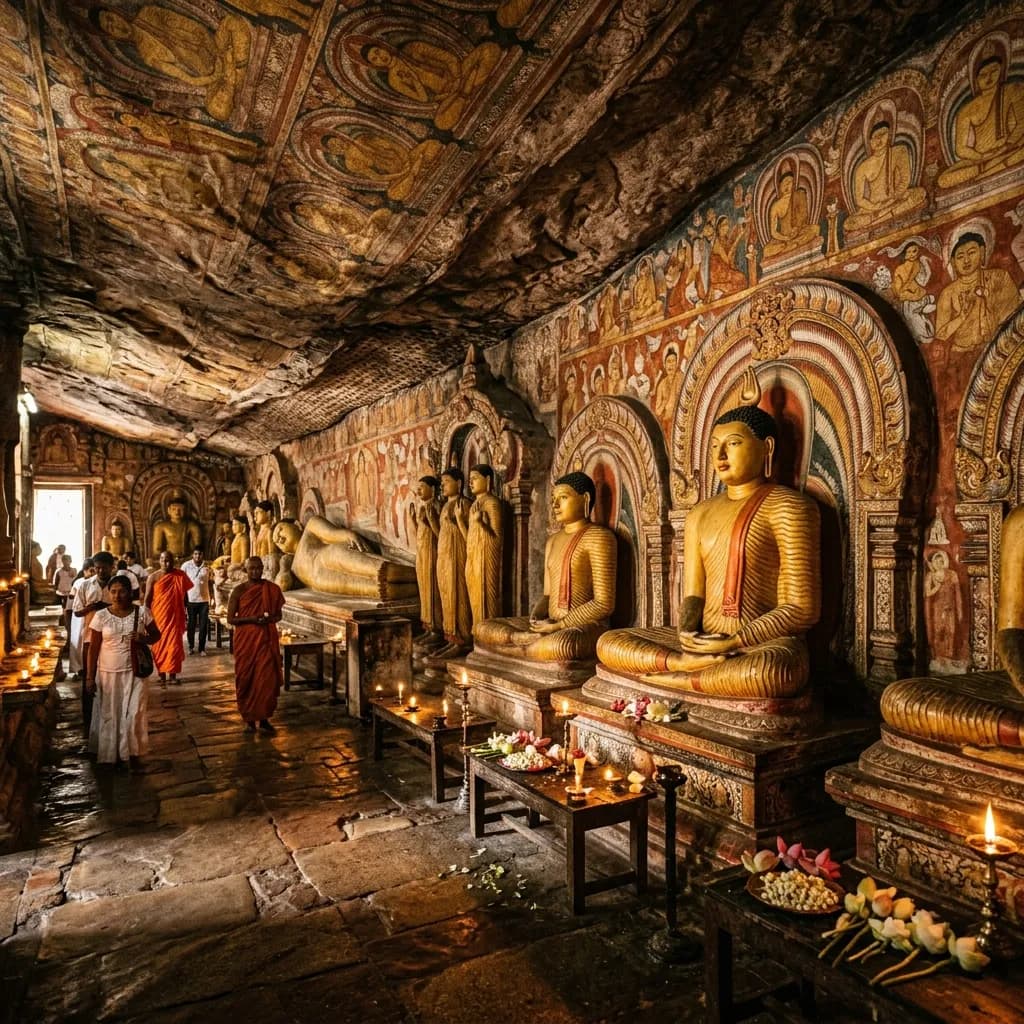
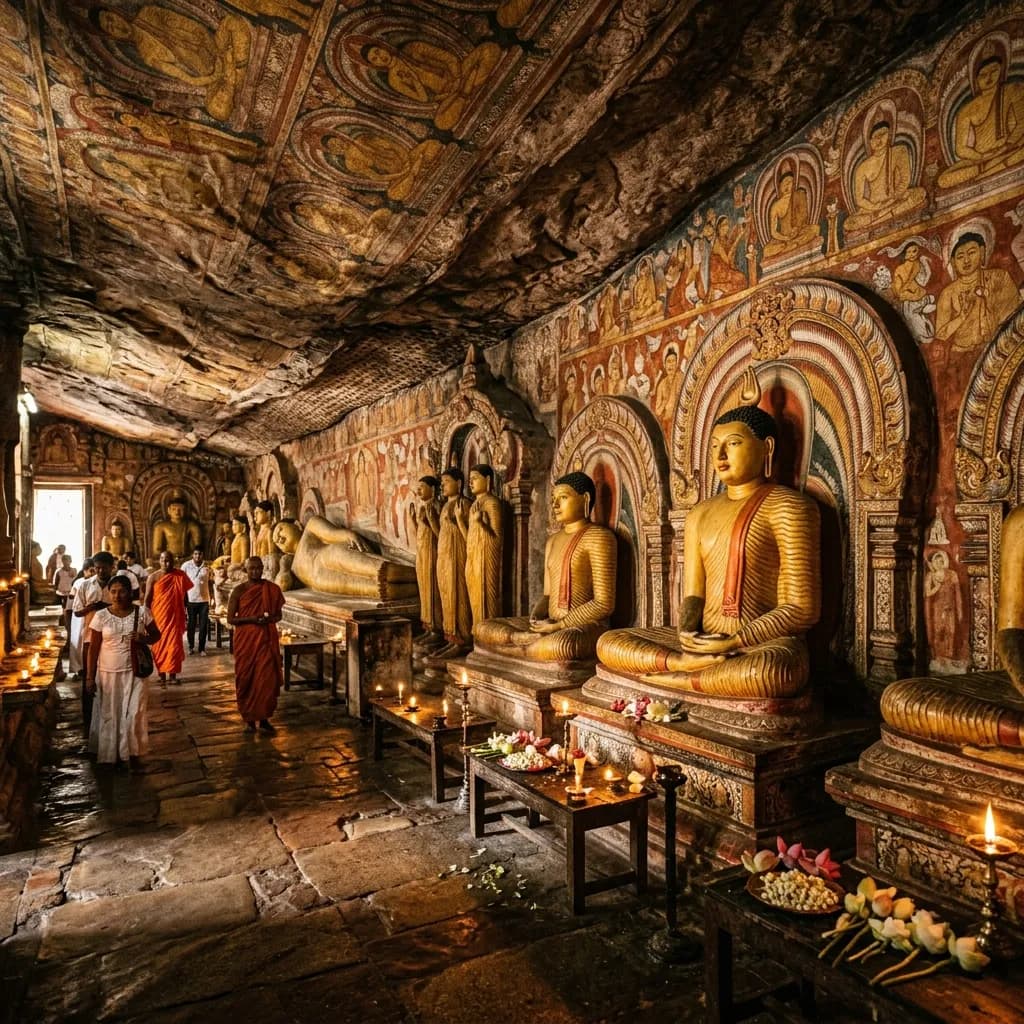
The [history of Dambulla Cave Temple](/destinations/dambulla/dambulla-cave-temple-history) goes back to the 3rd century BCE. Five separate cave shrines are cut beneath the natural granite overhang. Together they contain 153 Buddha statues and more than 2,100 square metres of painted ceiling murals , the largest preserved cave painting complex in South Asia. The oldest paintings date to the 1st century BCE, though they've been repainted and added to across the centuries.
None of that sounds immediately legible when you're standing outside in bright sun at the base of the steps. The scale becomes apparent inside. Cave Two , Maharaja Viharaya , is the largest. The ceiling is entirely covered in painted scenes from the Buddha's life, arranged in a continuous horizontal band. The cave is also lined with 56 statues of the Buddha, two statues of kings, and painted figures of Hindu deities, which gives you a sense of how religious practice in Sri Lanka has never drawn strict boundaries between Buddhist and Hindu traditions.
This is still an active pilgrimage site. Monks use these caves daily. Pilgrims leave flowers and light oil lamps at the feet of the statues. The Dambulla Cave Temple isn't a ruin you walk through , it's a living space that happens to be very, very old. Give it two hours minimum. Don't rush the caves to make time for something else.
Sigiriya: What Lion Rock Actually Is
Sigiriya is often described with the language of superlatives , one of the greatest archaeological sites in Asia, possibly the Eighth Wonder of the World. Those descriptions are correct, but they don't quite explain what makes it remarkable.
King Kasyapa built a royal palace on the summit of a 200-metre granite rock in the 5th century CE. Getting there meant engineering a staircase, terraced water gardens at the base, and a gateway through the carved stone paws of a lion , hence the name Sigiriya, from the Pali sīhagiri, meaning Lion Rock. The lion's body is gone. The paws remain, and you walk between them.
The [Sigiriya Rock climb](/destinations/dambulla/climbing-sigiriya-lion-rock) passes three things before the summit that would justify the entrance fee on their own.
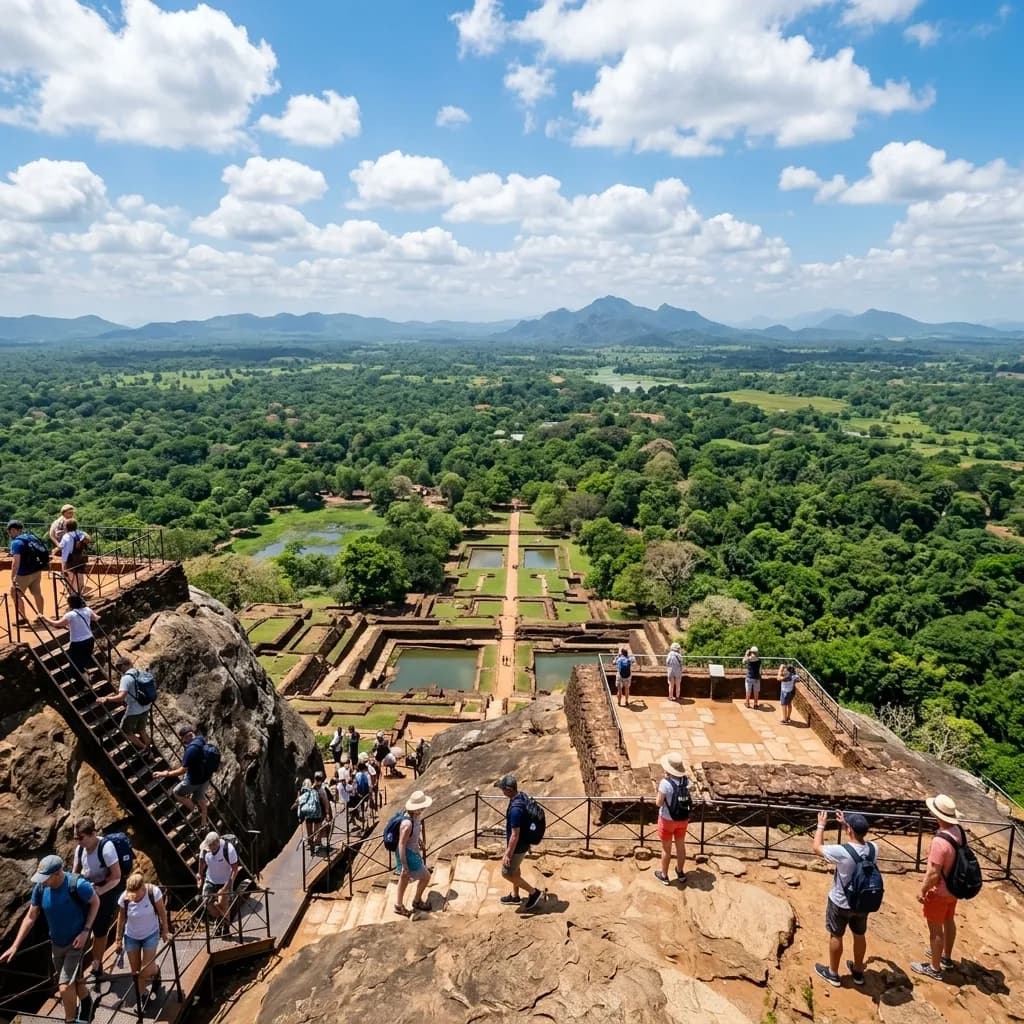
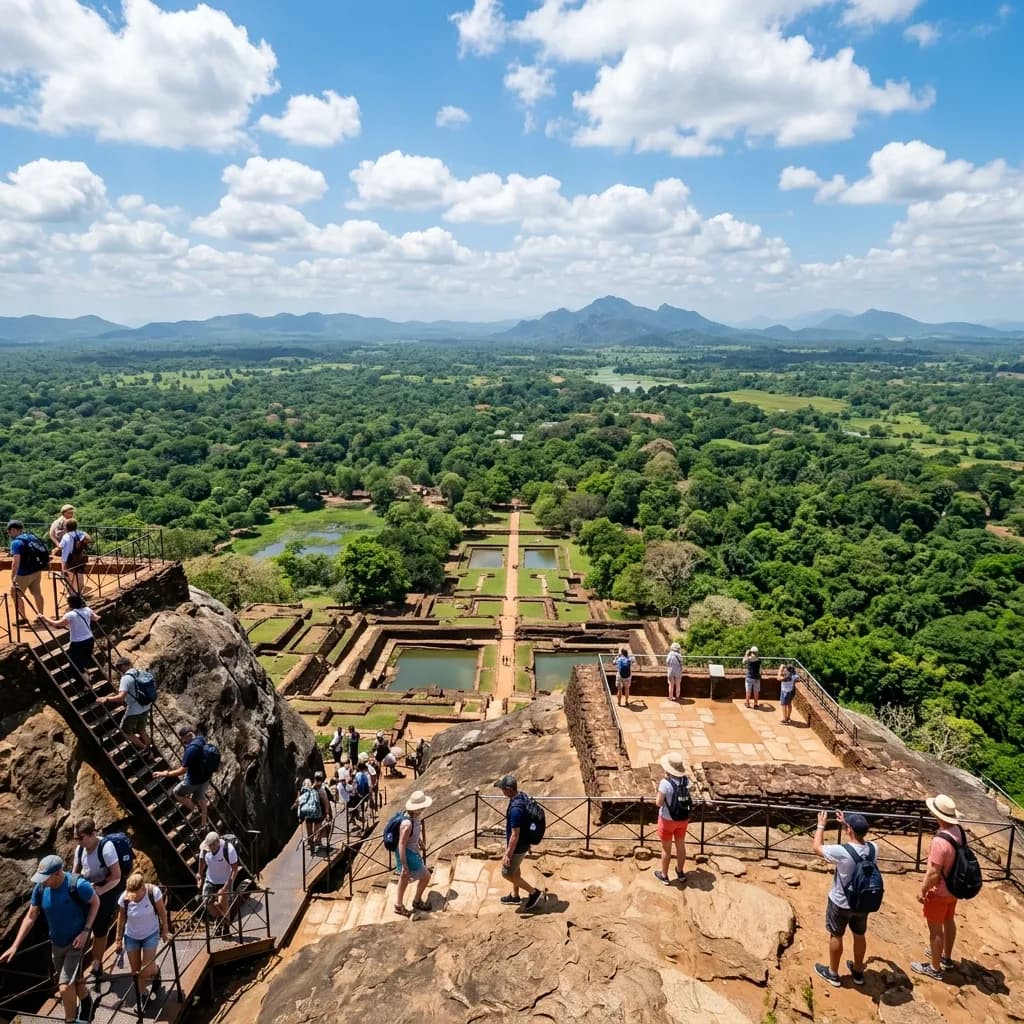
The water gardens at the base are geometrically precise , symmetrical pools, moats, and hydraulic fountains laid out with a formality that still works. Several of the gravity-fed fountains still run during the monsoon season. Standing in them in early morning with mist on the water is one of those travel moments that doesn't photograph well but stays with you.
Halfway up, the Mirror Wall and the Sigiriya Frescoes occupy a sheltered gallery cut into the cliff face. The frescoes , painted female figures, probably representing celestial maidens or the king's consorts , are between 1,400 and 1,500 years old. The colours still hold: terracotta, amber, cream. They were painted with mineral pigments mixed with lime and honey. The Mirror Wall beside them was once polished smooth enough to reflect the paintings above, and visitors wrote poems on it in the 6th century onward. Some of the poetry is still legible.
The summit is a complex of ruined foundations , bathing pools, throne platforms, garden terraces , above 360 degrees of flat jungle. What you see from the top is how flat everything else is. The rock's isolation is what made it defensible. It's also what makes the view so disorienting.
Dambulla to Sigiriya: The Practical Geography
The drive between the two sites takes around 20 to 30 minutes on the A9 highway. Dambulla sits at a road junction , the A6 from Kandy meets the A9 here , which makes it a natural base for exploring both sites and the wider region.
Most visitors coming from Kandy reach Dambulla in two to three hours. Coming from Colombo, the drive is around three to four hours. Sigiriya is a further half hour north.
Tuk-tuks are available from Dambulla town to Sigiriya. Some guesthouses in Dambulla can arrange transfers. If you have a private driver, the standard approach is to visit the Cave Temple in the morning when the light is good inside the caves, then drive to Sigiriya for an early afternoon start , though an early-morning Sigiriya visit means arriving before 7 AM to beat the crowds, which is a different kind of planning.
If you only have one day, Dambulla in the morning and Sigiriya in the afternoon is manageable but tight. Both sites involve significant walking. Both are more enjoyable when you're not rushing to the next thing.
Dambulla or Sigiriya: Why Visit Both?
This is the question most people ask before they arrive, and stop asking once they're there.
Dambulla and Sigiriya are not competing versions of the same experience. They don't overlap in any meaningful way. One is carved into the earth; the other asks you to climb above it. One is about religious continuity across 22 centuries; the other is about the ambition of a single king in a single decade. One is cool and dim and requires patience. The other is exposed, physical, and rewards arriving before the crowds.
What they share is age, scale, and the feeling of being somewhere that has been important to people for a very long time.
Visiting only Sigiriya and skipping Dambulla is the most common mistake foreign travellers make in this part of Sri Lanka. Sigiriya gets the photographs. Dambulla is harder to describe, which is exactly why it tends to land differently.
The Cultural Triangle: What It Actually Means
The Cultural Triangle is a designation by the Sri Lankan government and UNESCO covering the ancient royal cities and heritage sites of the island's north-central interior. The three main points of the triangle are Kandy in the south, Anuradhapura in the north, and Polonnaruwa in the northeast.
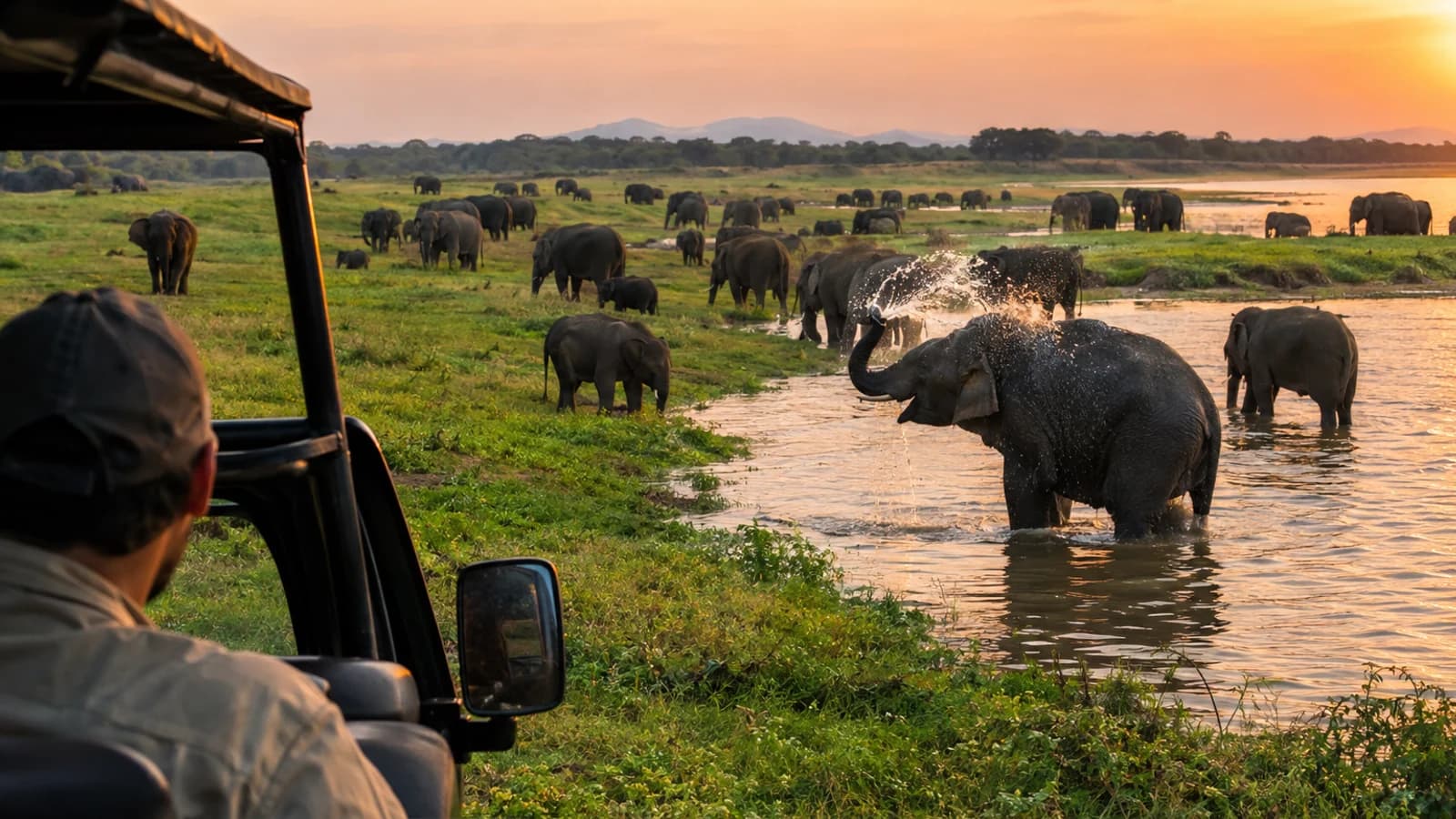
Dambulla and Sigiriya sit inside the triangle's boundaries , not at its corners, but at its heart. Both are UNESCO World Heritage Sites. The wider region also contains Minneriya National Park (one of the best places in Sri Lanka to see wild elephants), the rock fortress of Ritigala, and the ruins of Aukana, where a 13-metre standing Buddha statue has been intact for fifteen centuries.
Polonnaruwa , another day's drive northeast , is the next logical step if you're moving through the Cultural Triangle. It's a medieval royal city with an extraordinary collection of stone structures, tanks, and sculpture, most of it from the 11th and 12th centuries CE. It deserves its own time and its own article.
Questions Travellers Ask About Dambulla and Sigiriya
How far is Dambulla from Sigiriya? Around 17 kilometres, or roughly 20 to 30 minutes by road. Both are easily visited from Dambulla town, which makes a practical base for the area. Sigiriya village also has accommodation if you prefer to stay closer to the rock.
How long does it take to climb Sigiriya Rock? The climb to the summit and back takes most people two to three hours including time at the top. Allow more if you want to spend time in the water gardens or at the frescoes. Starting before 7 AM is recommended to avoid the midday heat and peak crowds.
Is Dambulla Cave Temple hard to visit? The climb to the cave entrance is around 364 steps, which takes 15 to 20 minutes at a steady pace. The caves themselves are level once you're inside. Remove footwear before entering , the stone steps and courtyard can get hot. Early morning or late afternoon is cooler.
Can you do Dambulla and Sigiriya in one day? Yes, but it's a long and tiring day. Dambulla in the morning and Sigiriya from early afternoon gives you enough time at each site, but both are more enjoyable with two days. Staying overnight in the Dambulla-Sigiriya area lets you start Sigiriya at sunrise and spend real time inside the caves without rushing.
What is the Cultural Triangle of Sri Lanka? It refers to the cluster of UNESCO-listed ancient sites in Sri Lanka's north-central interior. The triangle's main cities are Kandy, Anuradhapura, and Polonnaruwa. Dambulla and Sigiriya sit within the triangle and are among the most visited sites in the region.
Two Sites, One Journey
Dambulla and Sigiriya were built for completely different reasons, by different people, in different centuries. What they share is the ambition of the people who made them and the landscape that surrounds them both , flat dry-zone jungle, enormous blue sky, granite rock that has been here long before any of the structures on it.
Seeing them together, within a day or two of each other, gives you a sense of the depth of Sri Lanka's ancient history that neither site can provide on its own.
Want to explore more?
Download our comprehensive E-Travel Guidebook for this destination.