The Dutch Colonial Legacy: Walking Galle Fort's Ramparts at Sunset
By Stay Lanka Travels
Walk the 17th-century ramparts of Galle Fort at sunset and discover the Dutch colonial history written into every stone, cannon emplacement, and coral bastion.
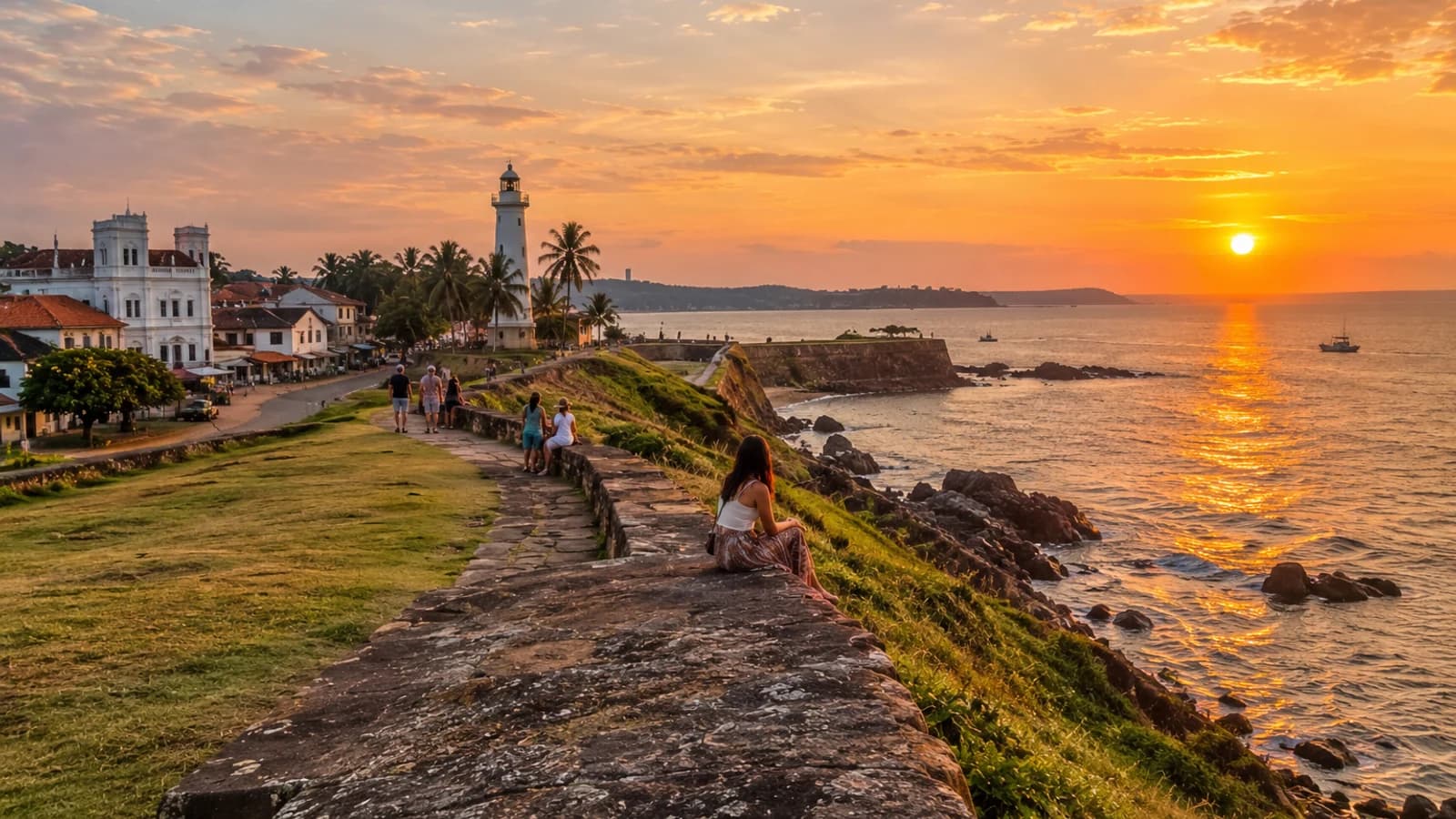
It's 5:15 PM and the Indian Ocean turns copper-pink in front of you.
You're standing on a 17th-century cannon platform, barefoot on warm granite, with nothing between you and the horizon except salt air and the faint outline of a fishing boat heading out for the night.
Below the parapet, four-metre-thick coral walls drop straight into the sea. Behind you, terracotta rooftops and church spires catch the last of the afternoon light.
This is Galle Fort's sunset rampart walk — and it's one of the most genuinely beautiful things you can do in Sri Lanka.
But here's what most people miss: the walls themselves are the story. Every cannon niche, every carved monogram, every stone step has a reason it's there. Once you know what you're looking at, this walk becomes something else entirely.
Why the Dutch Built These Walls (And What They Were Really Afraid Of)
The Portuguese got here first: they threw up a basic timber stockade at Galle harbour in 1589. It worked well enough for trade, but it wasn't built to last.
When the Dutch East India Company (VOC) seized Galle in 1640, they had bigger plans. The VOC was running one of the most profitable commercial empires in the world at that point. Cinnamon, pepper, and gems were flowing through Galle harbour by the shipload. They needed walls that could stop a cannon, not just keep out the rain.
Between 1663 and 1729, they rebuilt the entire fortification from scratch using three specific materials:
- Coral stone cut from the reef offshore, cheap, abundant, and surprisingly strong
- Granite shipped from India for load-bearing sections and the main gate archways
- Lime mortar made from burnt coral mixed with local clay
The result was a fortress covering 36 hectares with 14 bastions, three landward gates, and rampart walls up to six metres high in places. The VOC's primary threat wasn't other Europeans; it was the Kandyan Kingdom in the highlands, who never fully accepted Dutch coastal control.
That fear shaped every defensive decision. Gun embrasures face inland as much as they face the sea.
The Rampart Route: Where to Start and What You'll Walk Past
Start at the Main Gate, the big archway on the north side built by the British in 1873. Look up at it, then immediately turn left and find the older Dutch Old Gate just 80 metres away near the harbour wall.
The Dutch Old Gate, built in 1669, is the real starting point. On its outer face: the British Royal Coat of Arms, added in the 1800s. Walk through the tunnel and look up: you'll see the original VOC monogram stamped into the stone: a V, O, and C overlapping. Two carved lions flank it. This single archway tells you 350 years of colonial handovers in one glance.
From here, follow the harbour rampart southwest. The walk to Flag Rock is about 900 metres and takes 25 minutes at a slow pace.
Along the way, you'll pass:
- Zwart Bastion: the oldest intact Dutch fortification on the island, built in 1640, the same year the VOC took the fort
- Point Utrecht Bastion: where a whitewashed lighthouse now sits, built by the British in 1938 on top of the old Dutch gun platform
- Flag Rock: where the VOC hoisted signal flags to communicate with incoming ships
Most people stop at Flag Rock. The sunset crowd is always thick there. Keep walking.
The Quiet Bastions Most People Skip
Round the southwestern corner past Flag Rock and the crowds thin out immediately.
Triton Bastion is 200 metres further along the oceanward wall. It juts out into the sea at the fort's southwestern tip and has a flat stone platform that once held four brass cannons covering the southern approach to the harbour.
Sit here at 5:30 PM. Facing west, you get an unobstructed 180-degree view across open ocean. The waves hit the coral base of the wall directly below you. In the wet season, spray actually reaches the parapet.
Continue north along the western wall and you reach Star Bastion, named for its five-pointed Dutch defensive star design, which you can only appreciate properly from a map or aerial view. From here you look across Galle Bay toward the jungle headland of Rumassala, which according to local legend is the spot where Hanuman dropped a piece of Adam's Peak while carrying medicinal herbs during the Ramayana.
The last section brings you to Moon Bastion and Sun Bastion on the northern land wall. These two face the modern city. The view is jarring: inside the walls, 17th century; outside the walls, Sri Lankan rush hour. The contrast is oddly satisfying.
Full circuit: approximately 2.5 kilometres. Allow 60 to 90 minutes if you stop at each bastion.
What Is Galle Fort's Rampart Walk Actually Like?
This section answers the most common questions about the experience.
Is it walkable in flip-flops? Technically yes, but the rampart pavers are uneven and some sections have no railing on the seaward side. Wear closed sandals or light trainers.
Is it free? The rampart walk itself is completely free. You pay nothing to walk the walls. Entrance fees apply only if you go into specific museums inside the fort.
What time is best? For sunset, arrive at the Main Gate by 5:00 PM. Sunset in Galle sits between 6:00 PM and 6:30 PM depending on the season. The golden hour light hits the coral walls and makes everything glow.
Is it safe at night? The ramparts are unlit after dark and some sections have low walls over a significant drop to the sea. Don't walk the ocean-facing sections at night. The interior streets of the fort are perfectly safe after dark.
How long is the walk? The full circuit of all ramparts is 2.5 km. The most popular section (Main Gate to Flag Rock and back) is about 1.8 km return.
Practical Things to Know Before You Go
Galle Fort is 130 kilometres south of Colombo. The fastest option is the highway, about 1 hour 45 minutes by car or air-conditioned bus.
The train is slower (2.5 to 3 hours from Fort Station in Colombo) but runs along the coast for much of the journey. Sit on the left side heading south. It's worth it once.
Once inside the fort:
- Bring water. The rampart walk is fully exposed. Between noon and 4 PM, the granite pavers radiate heat and there's no shade at all.
- The best photography light is 5:00–6:30 PM. The coral stone changes colour dramatically as the sun drops: it goes from sandy yellow to deep amber to near-orange in the last 20 minutes before sunset.
- Don't rush the Old Gate. Most people walk straight past it. Stop, go through the tunnel, and look at both faces of the archway. It takes three minutes and it's genuinely remarkable.
- Respect the residents. People actually live inside the fort. The houses along the rampart streets are private homes, not exhibits. Keep voices down in the residential lanes after dark.
What Makes Galle Fort Different From Every Other Colonial Fort in Asia
There's no shortage of old European forts across Asia — Penang, Malacca, Cochin, Colombo. Most of them are ruins, museums, or tourist zones where the history has been carefully curated into signs and barriers.
Galle Fort is different because it's still inhabited. Around 400 families live inside the walls. Children kick footballs on the grassy bastion slopes. Elderly residents sit on verandah chairs in the afternoon shade. The mosque on the harbour side calls out the azan at dusk. Church bells follow ten minutes later.
The Dutch built these walls to protect a trade monopoly. Today they protect a neighbourhood. That shift, from commerce to community, is what makes this place feel like somewhere rather than something.
Walk the ramparts at sunset and you're not looking at history behind glass. You're standing in the middle of it while the light changes colour around you.
Come to Galle with at least one evening free. Walk the walls slowly. Sit at Triton Bastion and watch the fishing boats head out to sea.
That's the one thing you'll remember about Sri Lanka's south coast.
Want to explore more?
Download our comprehensive E-Travel Guidebook for this destination.