Trincomalee Travel Guide: Beaches, Pigeon Island & Koneswaram Temple
By Stay Lanka Travels
Plan a Trincomalee trip with the best beaches, Pigeon Island snorkelling, Koneswaram Temple, Fort Frederick, marine excursions, and east-coast travel tips.
There is a particular quality to the light on Sri Lanka's east coast — wider, somehow, than anywhere else on the island, the horizon unobstructed, the sea shading from jade to cobalt as the depth increases beneath your feet. Trincomalee captures that quality completely. Ringed by one of the great natural harbours of the world, flanked by long arcs of pale sand, and anchored by a cliff-top Hindu temple that has drawn pilgrims for more than a thousand years, Trinco — as travellers quickly learn to call it — rewards every kind of visitor: the diver chasing reef sharks at dawn, the history lover tracing colonial fortifications, the family content to float for hours in warm, calm water while the rest of the world rushes on elsewhere.
Why Trincomalee Belongs on Every East-Coast Itinerary
Geographers and admirals have long agreed that Trincomalee Harbour is one of the finest natural anchorages on earth — deep enough for the largest vessels, sheltered by headlands on three sides, wide enough to swallow a fleet without crowding. That strategic reality shaped centuries of history. The Portuguese arrived in 1624, the Dutch took over in 1639, and the British held it from 1795 through independence, transforming the bay into a critical Royal Navy base. During the Second World War, Trincomalee served as the headquarters of the Eastern Fleet, and in April 1942, Japanese aircraft raided the harbour in a strike that sank the carrier HMS Hermes off the coast — a wreck now visited by divers. Stand anywhere above the waterline and the harbour's extraordinary scale becomes immediately clear: blue water stretching toward low headlands, freighters passing in the middle distance, fishing outriggers cutting white lines across the foreground.
What makes Trincomalee exceptional today is the combination of that layered history with a coastline that belongs firmly in the Indian Ocean's first rank. Within a short tuk-tuk ride of town you have two distinct beach villages — the livelier Uppuveli and the quieter, more expansive Nilaveli — plus a marine national park, whale-watching grounds, ancient hot springs, and a temple perched above a vertical cliff that drops straight to the sea. Few places in Sri Lanka ask you to choose between this many pleasures simultaneously.
Nilaveli and Uppuveli: Two Beaches, Two Moods
Uppuveli — The Social Shore
Uppuveli begins roughly 4 kilometres north of Trincomalee town and runs for a generous stretch of powdery sand backed by casuarina trees, guesthouses painted in bright whites and blues, and a row of open-sided beachfront restaurants that come alive in the late afternoon. This is where most independent travellers end up basing themselves — and for good reason. The accommodation here ranges from simple family guesthouses charging around LKR 4,000–6,000 per night for a fan room to small boutique properties with garden pools. The restaurants turn out freshwater crab cooked in a dry spice rub, tiger prawns in garlic butter, and whole grilled snapper caught the same morning, often for well under LKR 1,500 a plate. Sit at a table in the sand, order a fresh king coconut before your meal, and watch the fishermen pull their catamarans up the beach as the sun sets behind you — this is Uppuveli at its most unhurried best.
The swimming here is calm and predictable during the season, though you will occasionally share the shallows with small jellyfish after certain wind shifts. Boat trips to Pigeon Island depart from the beach in front of the larger guesthouses, with operators quoting around LKR 1,500–2,500 per person for the crossing. Snorkelling gear rental is widely available, and experienced operators can arrange PADI-certified diving on the WWII wreck of HMS Hermes lying roughly 55 metres below the surface offshore.
Nilaveli — The Quiet Coast
Drive a further 11 kilometres north and the road opens onto Nilaveli, a beach of such uninterrupted length and clarity that it can feel almost otherworldly on a quiet weekday. The water is brilliantly transparent — in the shallows you can count the individual grains of sand beneath your feet — and the gentle slope means the sea stays manageable for children and non-swimmers far from shore. Hotels here tend toward the larger resort format, and the pace of life is noticeably slower. There are fewer restaurants immediately at hand, so self-catering travellers should stock up in town, but the trade-off is a stretch of coast that rarely feels crowded even in peak season. Nilaveli is a place for mornings with a book and long swims and nothing particularly scheduled — which, in this part of Sri Lanka, is not a small thing.
Pigeon Island National Park: The Reef Below the Surface
Pigeon Island sits about two kilometres offshore from Nilaveli, and the national park that bears its name is one of Sri Lanka's most visited marine reserves. The name comes from the blue rock pigeon colony that nests on the larger of the two small islands; spend a few minutes on the beach before entering the water and you will understand — the birds wheel constantly overhead, indifferent to the boats arriving and departing all morning. The national park entrance fee is approximately LKR 1,500–2,000 for foreign visitors, payable on arrival, and the park office asks that you snorkel only in designated zones to protect the recovering coral.
What you find below the surface more than justifies the trip. The reef around the island holds table corals, brain corals, and staghorn formations in reasonable health, populated by moorish idols, parrotfish, surgeonfish, and the occasional turtle moving slowly over the bottom in a way that seems profoundly indifferent to human company. The signature sighting is the blacktip reef shark: these sleek, nervous creatures patrol the outer edge of the reef and are genuinely wild — no feeding, no baiting — which makes the encounter feel earned. Snorkellers regularly see four or five individuals in a single session. Divers working deeper can explore more dramatic coral architecture and encounter larger schools of fish on the ocean-facing side of the outer island. Go as early in the day as your operator allows; visibility is best before 10 a.m. and the boats multiply rapidly toward midday.
Koneswaram Temple and the Cliffs of Swami Rock
A Sacred Headland
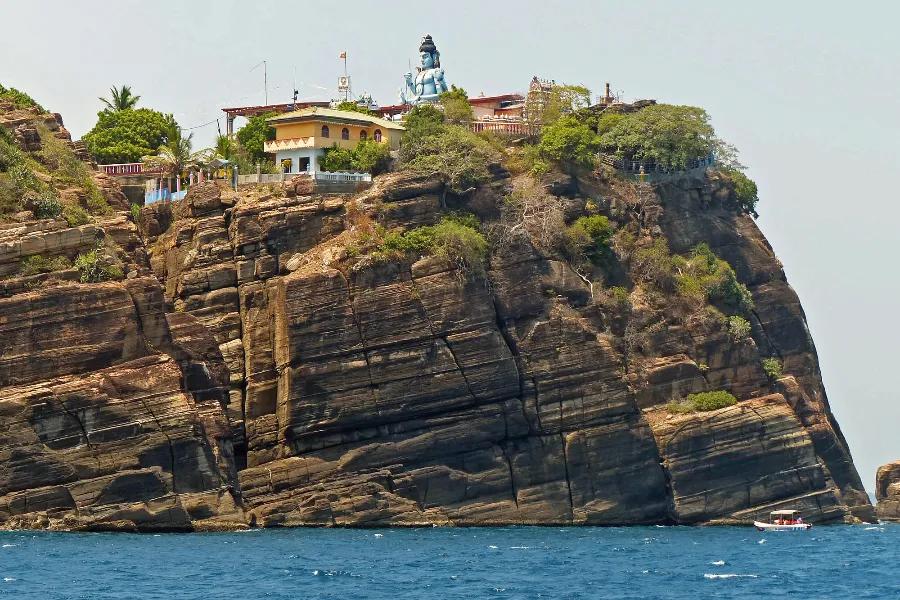
The approach to Koneswaram Temple runs through the gates of Fort Frederick and up a winding road that ends at one of the most dramatic positions of any place of worship in Sri Lanka. The temple itself, painted in rich ochres and reds and rising in the tiered gopuram style of South Indian sacred architecture, stands at the very tip of Swami Rock — a granite headland that drops 130 metres in a near-vertical cliff directly to the harbour below. The site has been sacred for more than two millennia; Tamil literary references to the Koneswaram shrine date back to at least the 1st century CE, and the legend holds that the original temple was partially demolished and pushed into the sea by the Portuguese in 1624. Some of those original carved stones were recovered by divers in the 1950s and are now displayed in the temple complex. Inside, a black stone Shiva lingam is the focus of daily puja, and the smell of camphor and flower offerings drifts out through the entrance as pilgrims move in quiet circumambulation around the inner sanctum.
Visitors of all backgrounds are welcomed, though removing footwear and dressing modestly — shoulders and knees covered — is expected. At the cliff's edge, a small platform marks what local tradition calls Lover's Leap, the point from which, according to a seventeenth-century Dutch account, a young woman named Francina van Rhede jumped to her death after a disappointed romance. The view from that platform, haunted or not, is stunning: the full sweep of the harbour, the distant headlands, and directly below, the vivid green water breaking against the base of the cliff in white trails of foam.
Fort Frederick: Colonial Stones and Free-Roaming Deer
Fort Frederick was first built by the Portuguese in 1623, then captured and expanded by the Dutch, and finally taken by the British in 1795, who held it until Sri Lankan independence in 1948. Today it functions as a Sri Lankan Army base, but the gates are open to respectful visitors during daylight hours. Walking in, you pass through an archway of genuine antiquity — weathered stone bearing the Portuguese coat of arms still visible in relief — and emerge into a compound where the improbable coexists with the historical: a herd of spotted deer grazes freely between the buildings, entirely unbothered by the occasional truck or passing visitor. The deer have been here so long that they appear on old postcards of the fort; nobody quite remembers when they arrived or how the arrangement started. The compound also contains Wellington House, a modest white building where the young Arthur Wellesley — later the Duke of Wellington — reportedly stayed briefly in 1799. Walk to the far end of the compound for one of Trincomalee's best unobstructed views of the harbour before continuing up to the temple.
Whale Watching and the Kanniya Hot Springs
Blue Whales Off the East Coast
Between April and September, the waters off Trincomalee become one of the most reliable places on earth to watch blue whales — the largest animals that have ever lived. The continental shelf drops sharply not far from shore, concentrating the upwelling that feeds these extraordinary creatures. A typical whale-watching excursion departs around 6:30 a.m., runs two to four hours offshore, and costs approximately LKR 4,000–6,000 per person including park fees. Sperm whales, spinner dolphins, and flying fish are common supporting cast. No sighting is guaranteed, but success rates with established operators during peak season are high enough that most people who make the trip come back with something unforgettable in their memory — a blue whale surfacing thirty metres from the bow, the slow roll of the dorsal fin, the deep exhalation of a breath held for forty minutes underwater.
The Seven Springs at Kanniya
Eight kilometres from Trincomalee town, tucked inside an unassuming concrete enclosure near a small Hindu temple, the hot springs at Kanniya are one of the east coast's quietest and most curious attractions. Seven brick-lined wells rise from the same geological source, each one slightly different in temperature — ranging from warm to genuinely hot — and legend attributes the springs to King Ravana, who is said to have caused them to bubble up in honour of his mother. Local pilgrims bathe here in the mornings for spiritual and physical benefit; visitors are welcome to do the same. Entry is free, the springs are busiest on weekends, and the site takes no more than forty-five minutes to explore properly. It makes an easy half-day pairing with a morning in town or a stop en route back from the northern beaches.
Practical Guide: Getting There and Getting Around
The train from Colombo Fort station to Trincomalee is a journey worth making for its own sake — roughly six to seven hours that pass through the green tank country of the North Central Province before the land flattens and the light takes on that particular eastern quality. First-class air-conditioned seats should be booked in advance, particularly on weekends; second-class observation saloon carriages offer open windows and a breeze. Buses from Colombo cover the same distance in a similar time and are cheaper, though less comfortable for a full day of travel. Once in Trincomalee, tuk-tuks are the standard way to move between town, Uppuveli, and Nilaveli — agree on a price before you get in; LKR 300–500 covers most short hops.
Where to stay: Base yourself in Uppuveli for access to restaurants and nightlife, or Nilaveli for a quieter, more resort-like experience. Avoid the town centre unless you have a specific reason to be there — it is functional but short on atmosphere.
A Suggested Three-Day Itinerary
Day 1 — Arrival and the Cliffs: Check in at your Uppuveli guesthouse, walk to Fort Frederick in the late afternoon, continue to Koneswaram Temple for sunset over the harbour, and return for fresh seafood on the beach.
Day 2 — Pigeon Island: Set an early alarm, eat a light breakfast, and board a boat to Pigeon Island by 7:30 a.m. Spend the morning snorkelling or diving. Return by noon, rest through the hottest hours, and join a whale-watching trip departing late afternoon if the season is right, or simply swim at Nilaveli before dinner.
Day 3 — Kanniya and Departure: Rise early for a tuk-tuk to the Kanniya hot springs, return to town for a fresh-rice lunch at a local restaurant, and catch your afternoon train back toward Colombo with the east light coming through the carriage windows behind you.
Final Thoughts
Trincomalee is a place that earns its reputation through accumulation rather than any single spectacle. The harbour that held navies, the reef that hides sharks in its clear shallows, the ancient temple balanced at the edge of a cliff, the deer wandering through a Portuguese fort as though colonial history were entirely their business — none of it shouts for attention, and all of it stays with you. Give yourself three full days at minimum. Arrive without a plan too rigid to bend. Eat whatever the fishermen brought in that morning. And at least once, find a spot above the water at dusk and watch the eastern sky change from gold to violet to the deep blue that belongs only to this coast. That moment, unhurried and unrepeatable, is what Trincomalee is really for.
Want to explore more?
Download our comprehensive E-Travel Guidebook for Ella.